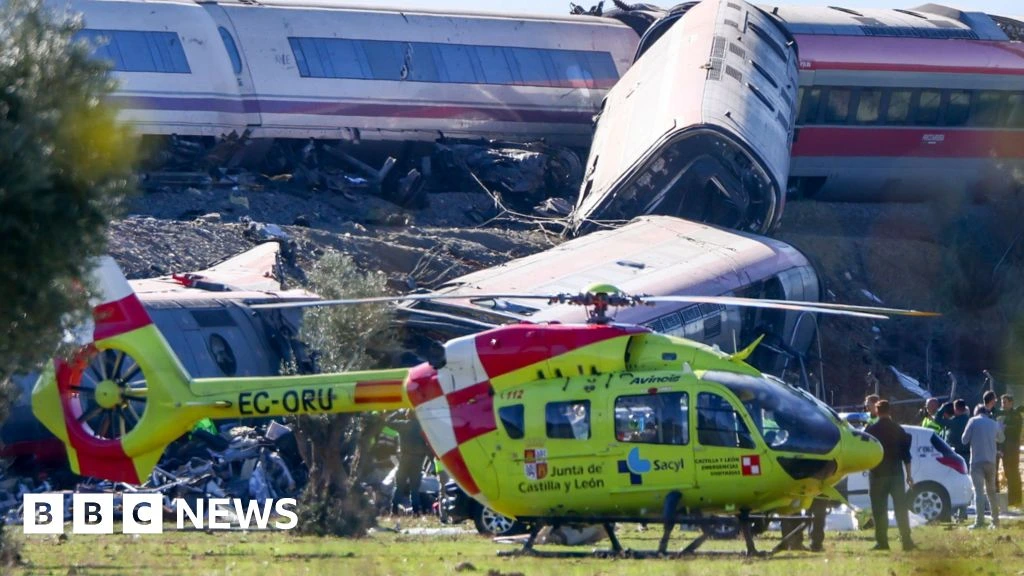
It was approaching 09:00 (08:00 GMT) and two high-speed trains were travelling south from the Spanish capital, Madrid, to Seville.
It was approaching 09:00 (08:00 GMT) and two high-speed trains were travelling south from the Spanish capital, Madrid, to Seville.
One, run by state-owned operator Renfe had 397 passengers on board. Ahead of it on the same line was a train of Iryo private operator with 147 passengers. A reported issue with the automatic signalling system - a computer failure - had forced all trains to halt on the affected stretch.
One, run by state-owned operator Renfe had 397 passengers on board. Ahead of it on the same line was a train of Iryo private operator with 147 passengers. A reported issue with the automatic signalling system - a computer failure - had forced all trains to halt on the affected stretch.
Then the impossible happened, Spain's transport minister said, as the Renfe train was ordered to proceed in "error".
Then the impossible happened, Spain's transport minister said, as the Renfe train was ordered to proceed in "error".
It crashed into the back of the other train between municipalities Mora and Orgaz, and about 140km (87 miles) south of Madrid.
It crashed into the back of the other train between municipalities Mora and Orgaz, and about 140km (87 miles) south of Madrid.
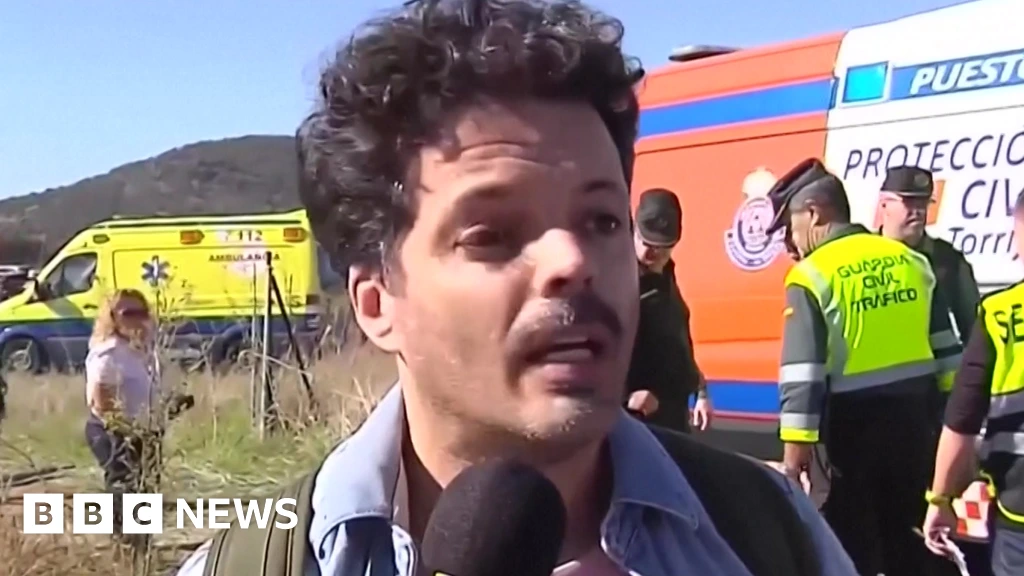
Spanish journalist Roberto Gómez was dozing on the high-speed Renfe train, when the train stopped and an announcement was relayed to passengers that there was congestion on the tracks.
Spanish journalist Roberto Gómez was dozing on the high-speed Renfe train, when the train stopped and an announcement was relayed to passengers that there was congestion on the tracks.
The train eventually began to move again, he explained, and then the crash happened.
The train eventually began to move again, he explained, and then the crash happened.
"The impact was terrible," he told Onda Cero radio. "You can imagine, the carriage is completely destroyed. All the suitcases are all over the wrecked carriage."
"The impact was terrible," he told Onda Cero radio. "You can imagine, the carriage is completely destroyed. All the suitcases are all over the wrecked carriage."
Gómez suffered only minor injuries but described another passenger falling on top of him and sustaining a deep gash on his head.
Gómez suffered only minor injuries but described another passenger falling on top of him and sustaining a deep gash on his head.
"We were able to help people who had suffered severe blows to their chest and ribs," he said.
"We were able to help people who had suffered severe blows to their chest and ribs," he said.
In the last carriage of the Renfe train, Miguel Ángel Pérez observed a similar scene.
In the last carriage of the Renfe train, Miguel Ángel Pérez observed a similar scene.
"It was a terrible crash. The carriage partially overturned," he told Spanish TV program La Hora de La 1. "Luckily there were few people standing," he said.
"It was a terrible crash. The carriage partially overturned," he told Spanish TV program La Hora de La 1. "Luckily there were few people standing," he said.
Passengers then jumped out of the carriage through the windows.
Passengers then jumped out of the carriage through the windows.
The train that was hit from behind was one of six to have been ordered to halt at 08:30. It was still stationary when the order was given to the Renfe train to proceed.
The train that was hit from behind was one of six to have been ordered to halt at 08:30. It was still stationary when the order was given to the Renfe train to proceed.
Transport Minister Óscar Puente appeared in front of the cameras to say an employee had ordered the resumption of travel at 08:36 and some 17 minutes later the "truly unbelievable" had happened.
Transport Minister Óscar Puente appeared in front of the cameras to say an employee had ordered the resumption of travel at 08:36 and some 17 minutes later the "truly unbelievable" had happened.
Sebastián Herrero from Seville was on the Iryo train and experienced the crash first hand.
Sebastián Herrero from Seville was on the Iryo train and experienced the crash first hand.
He felt a "terrible, terrible impact" and was thrown on to the seats in front of him, he told El Mundo newspaper.
He felt a "terrible, terrible impact" and was thrown on to the seats in front of him, he told El Mundo newspaper.
"After we fell, there were many people with broken noses, broken arms... We started seeing smoke everywhere."
"After we fell, there were many people with broken noses, broken arms... We started seeing smoke everywhere."
Another man, who was not identified, told Reuters news agency: "Everything was overturned. Some people were thrown into the air. They are very badly injured."
Another man, who was not identified, told Reuters news agency: "Everything was overturned. Some people were thrown into the air. They are very badly injured."
Eduarda was also on the stationary train, travelling with her two cats.
Eduarda was also on the stationary train, travelling with her two cats.
She told Cadena Ser radio how the crash had propelled her forwards.
She told Cadena Ser radio how the crash had propelled her forwards.
Once outside, the chaos hit her. She heard screams and saw people under the train who she said had died, and a carriage was on fire.
Once outside, the chaos hit her. She heard screams and saw people under the train who she said had died, and a carriage was on fire.
For Fernando Seco the worst came after he left the train and saw a "horrible scene".
For Fernando Seco the worst came after he left the train and saw a "horrible scene".
"There were many injured people, a lot of blood and many dead," he said.
"There were many injured people, a lot of blood and many dead," he said.
Some of the fortunate passengers who escaped injury in the crash began helping others. Even injured and bloodied passengers did their best to help.
Some of the fortunate passengers who escaped injury in the crash began helping others. Even injured and bloodied passengers did their best to help.
It was not long before local people arrived, followed by the police and ambulance services of the Guardia Civil.
It was not long before local people arrived, followed by the police and ambulance services of the Guardia Civil.
"People from neighbouring towns brought water," a volunteer told Reuters.
"People from neighbouring towns brought water," a volunteer told Reuters.
"We are distributing it, especially to be taken to the accident site where people are in worse condition."
"We are distributing it, especially to be taken to the accident site where people are in worse condition."
Some residents brought cars to help with the evacuation to the nearby town of Urda, he explained.
Some residents brought cars to help with the evacuation to the nearby town of Urda, he explained.
Spain was already reeling from the Adamuz high-speed rail disaster outside Córdoba in January, in which 46 people died.
Spain was already reeling from the Adamuz high-speed rail disaster outside Córdoba in January, in which 46 people died.
It happened on the same high-speed rail line, but much further south. So Wednesday's accident has raised many questions for the authorities.
It happened on the same high-speed rail line, but much further south. So Wednesday's accident has raised many questions for the authorities.
The Spanish transport minister said the circumstances were "inexplicable".
The Spanish transport minister said the circumstances were "inexplicable".
According to regulations, under such circumstances, a train driver would be required to proceed at what is known as "sight speed" - about 40km/h (25mph), a speed that allows them to stop in time if they encounter an obstacle.
According to regulations, under such circumstances, a train driver would be required to proceed at what is known as "sight speed" - about 40km/h (25mph), a speed that allows them to stop in time if they encounter an obstacle.
Officials will investigate what order the Renfe train got, if it was travelling at the usual speed for that section of track - "around 200km/h" according to the minister, and, more significantly, why did the operator not stop its journey when his screen would have displayed that another train on the same line was stationary.
Officials will investigate what order the Renfe train got, if it was travelling at the usual speed for that section of track - "around 200km/h" according to the minister, and, more significantly, why did the operator not stop its journey when his screen would have displayed that another train on the same line was stationary.
Affected passengers were visibly angry.
Affected passengers were visibly angry.
"It isn't possible that our train was stopped for five or 10 minutes and that the other train wasn't told to stop," one of them said.
"It isn't possible that our train was stopped for five or 10 minutes and that the other train wasn't told to stop," one of them said.
"How can this happen with the technology we have?," he added. "It's not normal. We weren't told anything. The person who should have been told something was the driver of the other train. We wouldn't have cared as long as the other train had been warned. I don't understand this."
"How can this happen with the technology we have?," he added. "It's not normal. We weren't told anything. The person who should have been told something was the driver of the other train. We wouldn't have cared as long as the other train had been warned. I don't understand this."